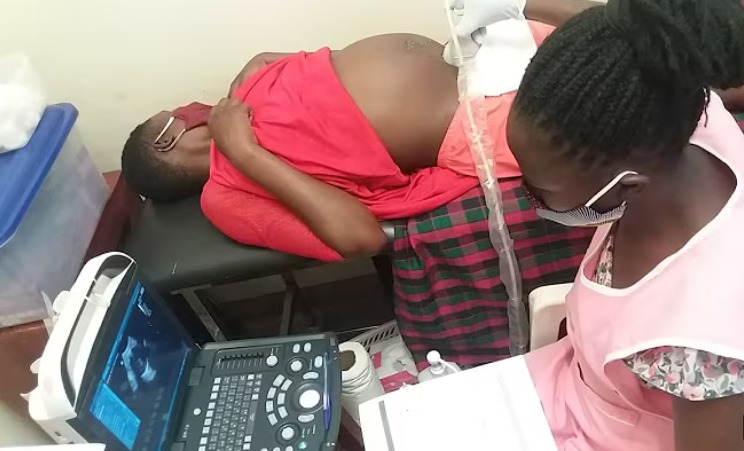
 A pregnant woman attending antenatal in Health centre in Uganda(MNCHCentreFilePhoto)
Uganda has recorded notable progress in reproductive, maternal, newborn, child and adolescent health (RMNCAH) over the past five years, with more women delivering in health facilities and fewer mothers dying from preventable causes. However, persistent regional disparities continue to threaten equitable access to essential maternal health services.
These findings are presented in the Analysis of Reproductive, Maternal, Newborn, Child and Adolescent Health (RMNCAH) Indicators for 2020–2025 report, which assesses national and subnational trends in service coverage, health outcomes and health system performance using routine health facility data.
According to the report, institutional delivery coverage increased from 68% in 2020 to 84% in 2025. While this reflects substantial national progress, performance varied considerably across regions.
Ankole (96.4%), Bugisu (104.0%) and Tooro (92.3%) recorded institutional delivery coverage above the national benchmark of 90%. In contrast, Bunyoro (68.2%), Busoga (68.5%) and Lango (71.0%) recorded considerably lower coverage, highlighting persistent regional inequalities in access to facility-based childbirth services.
Maternal and Perinatal Outcomes Improve
The report also documented improvements in maternal and perinatal health outcomes.
The institutional maternal mortality ratio declined by 38%, from 96.4 deaths per 100,000 live births in 2020 to 59.9 per 100,000 live births in 2025.
Similarly, the institutional stillbirth rate declined by approximately 37%, from 16.5 per 1,000 births in 2020 to 10.4 per 1,000 births in 2025.
Data Quality Remains Important for Interpretation
Although reporting completeness remained consistently high at between 97% and 99%, the overall data quality score declined from 91% during 2020–2022 to 83% in 2025.
The report identifies Ankole, Kigezi and Lango among the regions requiring further review because of data quality concerns. It notes that factors such as population movement, cross-border utilisation of health services and challenges in estimating target populations may contribute to unusually high coverage estimates and should be considered when interpreting the findings.
Health Workforce Gaps Continue to Constrain Services
While Uganda has made efforts to strengthen its health system and increase staffing at different levels of care, the report notes that staff when it comes to health workforce remains a significant challenge.
The analysis shows that health facility density stands at 3.1 facilities per 10,000 population, exceeding the benchmark of two facilities per 10,000 population.
However, health worker density remains at 7.7 health workers per 10,000 population, well below the World Health Organization’s recommended threshold of 23 health workers per 10,000 population.
Moving forward, the report recommends strengthening district health systems, improving routine data quality, expanding the health workforce and prioritising underserved regions to accelerate progress towards universal access to quality RMNCAH services by 2030.
Overall message
✓ Uganda has achieved substantial gains in RMNCAH outcomes since 2020, particularly reductions in maternal mortality, stillbirths, and neonatal mortality, demonstrating that investments in service delivery and quality improvement are yielding results.
✓ Despite national progress, significant subnational disparities persist, with some regions and districts continuing to lag behind in service coverage and health outcomes.
✓ The next phase of improvement will depend on strengthening data quality and resolving denominator inconsistencies to ensure reliable performance measurement and targeting of resources.
✓ Uganda’s MPDSR system has been a key contributor to mortality reduction and should continue to drive action on maternal, stillbirth, and newborn outcomes through stronger implementation of response actions.
✓ The most critical health system constraint according to the analysis in this report is the shortage and unequal distribution of skilled health workers, requiring targeted workforce investments in underserved areas.
✓ Going forward, the priority is to sustain national gains while focusing resources, workforce, and quality improvement efforts on districts and populations that are being left behind.
More about the Report
The Analysis of Reproductive, Maternal, Newborn, Child and Adolescent Health (RMNCAH) Indicators for 2020–2025 was undertaken through a partnership involving the Ministry of Health, Uganda; the African Population and Health Research Center (APHRC); Countdown to 2030; and the Makerere University Centre of Excellence for Maternal, Newborn and Child Health (MNCH Centre) at Makerere University School of Public Health.
The Country Analytical Team comprised Prof. Peter Waiswa and Ronald Wasswa from Makerere University School of Public Health; Jimmy Ogwal and Bruno Ssemwanga from the Ministry of Health; and Francesca Scott from the World Bank.
https://mnh.musph.ac.ug/wp-content/uploads/2026/08/Uganda_poster_v3-1.pdf